Directing actors is often described as one of the most challenging aspects of filmmaking—not because actors are difficult, but because no two actors create in exactly the same way. Some arrive on set with endless ideas and enough energy to power an entire production. Others quietly retreat into their characters, speaking only when necessary and revealing extraordinary performances when given the right environment.
The truth is, directing actors has less to do with giving instructions and more to do with understanding people.
A great director is part storyteller, part psychologist, and part translator. Your job isn’t to make every actor work the same way. It’s to figure out how each individual performs at their best—and sometimes, you have only a few minutes to do it.
Stop Directing Actors Like They’re All the Same
One of the biggest mistakes young directors make is assuming that actors respond to direction in similar ways.
They don’t.
Some actors want:
- Detailed emotional explanations.
- Physical objectives.
- Technical precision.
- Complete creative freedom.
- Constant feedback.
- Absolute silence before a take.
Treating every performer identically often leads to frustration on both sides.
Before giving direction, spend a few moments observing how your actors communicate.
Ask yourself:
- Are they naturally talkative or reserved?
- Do they think emotionally or analytically?
- Are they seeking reassurance or creative challenges?
- Do they seem energized or overwhelmed?
Actors will usually tell you how they prefer to work—you simply have to pay attention.
The Introvert Isn’t Difficult—They’re Processing
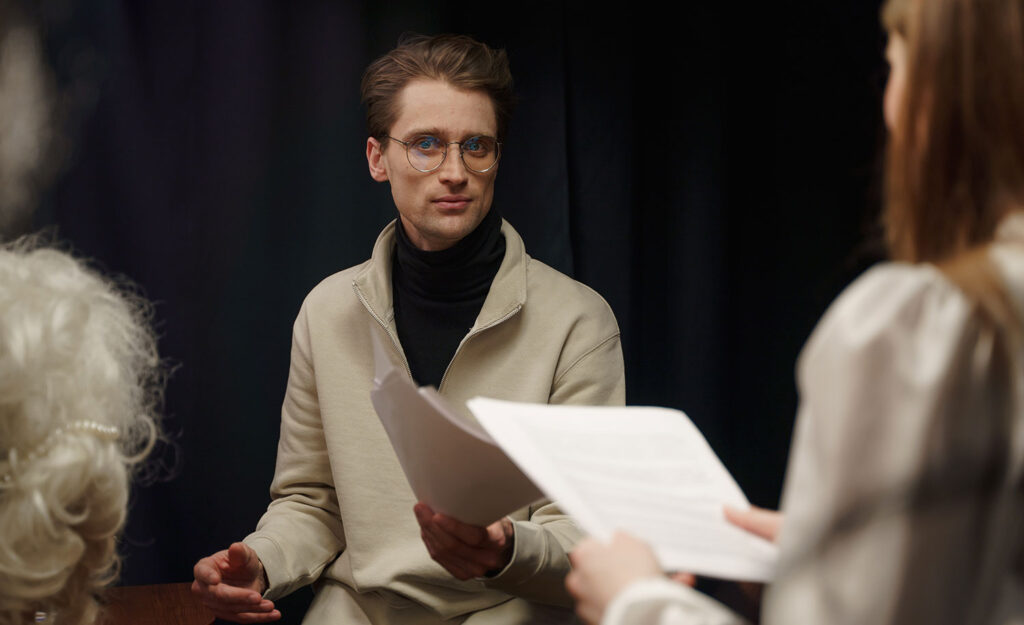
Quiet actors are sometimes misunderstood on film sets. Silence is often mistaken for insecurity, disinterest, or a lack of preparation.
In reality, many introverted performers are simply processing information internally.
If an actor gives short answers or avoids excessive conversation, resist the temptation to fill every moment with additional direction.
Instead:
- Ask simple, specific questions.
- Give them time to think.
- Avoid overwhelming them with excessive notes.
- Focus on the emotional objective of the scene.
For example, instead of saying:
“This scene is really about your relationship with your father, your fear of failure, and the symbolic meaning of the room.”
Try:
“Your character wants to stay, but they’re pretending they don’t.”
Short, clear direction is often far more effective.
Introverted actors frequently produce remarkable performances when they’re given space rather than pressure.
The Eccentric Actor Isn’t Chaotic—They’re Exploring
Then there’s the opposite personality type.
Every director eventually meets the actor who arrives with fifteen different interpretations of a scene, three unexpected costume ideas, and a completely new monologue they wrote during breakfast.
They are enthusiastic, imaginative, and occasionally terrifying when you’re already thirty minutes behind schedule.
The key is not suppressing that creative energy—it’s channeling it.
Allow them to contribute creatively while establishing clear boundaries:
- What absolutely cannot change?
- Where is experimentation encouraged?
- How much time do you have for alternatives?
Say things like:
“I love that idea. Let’s do one take exactly as planned, then we’ll play.”
This approach accomplishes two things:
- It acknowledges their creativity.
- It protects your schedule.
Creative actors perform best when they feel heard. They simply don’t always need unlimited creative freedom.
Give Objectives, Not Emotions
One of the most useful directing techniques works for almost every actor regardless of personality type:
Direct actions instead of emotions.
Instead of:
- “Be sad.”
- “Act confident.”
- “Look nervous.”
Try:
- “Don’t let them know you’re hurt.”
- “Convince them you’re telling the truth.”
- “Pretend you’ve already decided to leave.”
Actors perform actions. Emotions emerge naturally when the objective is clear.
This approach also reduces unnecessary overthinking and helps actors remain grounded in the reality of the scene.
Build Trust Quickly
Film sets move fast. You don’t always have weeks of rehearsal or extensive character discussions.
Fortunately, trust doesn’t necessarily require time—it requires clarity and respect.
Simple ways to establish trust include:
- Learning how actors prefer to communicate.
- Listening before giving notes.
- Being honest when something isn’t working.
- Remaining calm when problems arise.
- Giving direction confidently and concisely.
Actors feel safer when directors appear emotionally steady.
If you panic every time something goes wrong, your cast will feel it immediately.
Confidence is contagious. So is anxiety.
Know When to Stop Talking
Many directors believe they must constantly provide notes between takes. Sometimes, the most valuable direction is silence.
If a performance feels authentic, resist the urge to improve it simply because you feel obligated to say something.
After an excellent take, it’s perfectly acceptable to say:
“That was beautiful. Let’s do one more exactly like that.”
Not every moment requires a lecture about subtext and character psychology.
Over-directing can become just as problematic as under-directing.
Trust your actors enough to let them surprise you.
Create Different Spaces for Different Personalities
Film sets are emotionally demanding environments. Not every actor prepares for scenes in the same way.
Some performers need:
- Conversation.
- Music.
- Isolation.
- Physical movement.
- Rehearsal.
- Spontaneity.
Whenever possible, allow actors to prepare in ways that support their creative process.
The quiet actor sitting alone in the corner isn’t necessarily unhappy. The eccentric performer pacing around while talking to themselves isn’t necessarily distracted.
People create differently.
Great directors adapt to those differences instead of fighting them.
The Five-Minute Rule
If you’ve only got five minutes before the first take, focus on three simple questions:
- What does the character want in this scene?
- What is preventing them from getting it?
- What should the audience feel by the end?
Everything else is secondary.
Actors don’t need twenty pages of psychological analysis moments before filming. They need clarity, confidence, and permission to make truthful choices.
The simpler your communication becomes, the stronger your performances often become.
Direct Human Beings First
It’s easy to forget that actors arrive on set carrying all the things that make people human:
- Excitement.
- Anxiety.
- Fatigue.
- Creativity.
- Self-doubt.
- Curiosity.
The best directors aren’t simply good at directing performances—they’re good at working with people.
Your actors are not problems to solve or tools to control. They’re creative collaborators helping bring your vision to life.
Sometimes that means encouraging an introvert to speak up. Sometimes it means helping an eccentric performer focus their brilliant chaos.
And sometimes it simply means knowing when to listen.
Because great directing isn’t about getting actors to become who you want them to be.
It’s about creating the conditions that allow them to become the very best version of the characters they’re already capable of bringing to life.